
Sunday, December 9, 2018

Friday, September 22, 2017
The In Crowd
The In Crowd - original by Dobie Gray (1964)
The In Crowd - Ramsey Lewis Trio (1964)
The In Crowd - Brian Ferry (1974)
"A very swinging R&B track with clique-boasting lyrics that many would find “problematic” today, this did well for singer Dobie Grey in 1964, but even better that year for the Ramsey Lewis Trio, whose jazz version charted and made the song iconically cool. The 1974 Bryan Ferry cover recasts the song as a sinister semi-joke, capped by an incendiary and mad guitar solo by Davy O’List."
"Fifty years ago, the Ramsey Lewis Trio sat in a Washington, D.C. coffee shop, musing over what it could add to its set that evening. It was booked for a run at Bohemian Caverns — the group had issued a live album made at the nightclub, and it was gearing up to record a follow-up live album. Over walked a waitress, who inquired about the band's predicament.
Fifty years later, Lewis still remembers her name: Nettie Gray.
"She had a jukebox," Lewis says. "Jukeboxes in coffee shops — people don't know about that any more, but she went over to the jukebox and played: 'You guys might like this! Listen to this!'"
Her recommendation was "The In Crowd," sung by Dobie Gray — a popular hit at the time. Lewis and the band worked out an arrangement quickly, then ended their set with it that evening, to wild applause.
Fifty years later, that song remains Ramsey Lewis' biggest hit.
"If somebody had come up with another song that fit the style of what we wanted, there would not have been an 'In Crowd,' " he says."
Audio interview at this location http://www.npr.org/2015/05/16/407077725/50-years-ago-ramsey-lewis-joined-the-in-crowd
I'm in with the in crowd (Do-do-do)
I go where the in crowd goes (Do-do-do)
I'm in with the in crowd (Do-do-do)
And I know what the in crowd knows (Da-da-da-da)
Any time of the year, don't you hear? (Havin' a ball)
Dressin' fine, makin' time
We breeze up and down the street
We get respect from the people we meet
They make way day or night
They know the in crowd is out of sight
I'm in with the in crowd (Do-do-do)
I know every latest dance (Do-do-do)
When you're in with the in crowd (Do-do-do)
It's easy to find romance (Get down)
At a spot where the beat's really hot (Where we are bound)
If it's square, we ain't there
We make every minute count, yeah
Our share is always the biggest amount
Other guys imitate us
But the original's still the greatest
Yeah, yeah
Got our own way of walkin'
We got our own way of talkin', yeah
(Gonna have fun)
Anytime of the year, don't you hear? (Gonna have fun)
Spendin' cash, talkin' trash
Girl, I'll show you a real good time
Come on with me and leave your troubles behind
I don't care where you've been
You ain't been nowhere till you've been in
With the in crowd, yeah
Oh, with the in crowd (Yeah, yeah, yeah)
We got our own way of walkin', yeah (Yeah, yeah, yeah)
We got our own way of talkin' (Yeah, yeah, yeah)
In the in crowd
https://genius.com/Dobie-gray-the-in-crowd-lyrics
The In Crowd - Ramsey Lewis Trio (1964)
The In Crowd - Brian Ferry (1974)
"A very swinging R&B track with clique-boasting lyrics that many would find “problematic” today, this did well for singer Dobie Grey in 1964, but even better that year for the Ramsey Lewis Trio, whose jazz version charted and made the song iconically cool. The 1974 Bryan Ferry cover recasts the song as a sinister semi-joke, capped by an incendiary and mad guitar solo by Davy O’List."
"Fifty years ago, the Ramsey Lewis Trio sat in a Washington, D.C. coffee shop, musing over what it could add to its set that evening. It was booked for a run at Bohemian Caverns — the group had issued a live album made at the nightclub, and it was gearing up to record a follow-up live album. Over walked a waitress, who inquired about the band's predicament.
Fifty years later, Lewis still remembers her name: Nettie Gray.
"She had a jukebox," Lewis says. "Jukeboxes in coffee shops — people don't know about that any more, but she went over to the jukebox and played: 'You guys might like this! Listen to this!'"
Her recommendation was "The In Crowd," sung by Dobie Gray — a popular hit at the time. Lewis and the band worked out an arrangement quickly, then ended their set with it that evening, to wild applause.
Fifty years later, that song remains Ramsey Lewis' biggest hit.
"If somebody had come up with another song that fit the style of what we wanted, there would not have been an 'In Crowd,' " he says."
Audio interview at this location http://www.npr.org/2015/05/16/407077725/50-years-ago-ramsey-lewis-joined-the-in-crowd
I'm in with the in crowd (Do-do-do)
I go where the in crowd goes (Do-do-do)
I'm in with the in crowd (Do-do-do)
And I know what the in crowd knows (Da-da-da-da)
Any time of the year, don't you hear? (Havin' a ball)
Dressin' fine, makin' time
We breeze up and down the street
We get respect from the people we meet
They make way day or night
They know the in crowd is out of sight
I'm in with the in crowd (Do-do-do)
I know every latest dance (Do-do-do)
When you're in with the in crowd (Do-do-do)
It's easy to find romance (Get down)
At a spot where the beat's really hot (Where we are bound)
If it's square, we ain't there
We make every minute count, yeah
Our share is always the biggest amount
Other guys imitate us
But the original's still the greatest
Yeah, yeah
Got our own way of walkin'
We got our own way of talkin', yeah
(Gonna have fun)
Anytime of the year, don't you hear? (Gonna have fun)
Spendin' cash, talkin' trash
Girl, I'll show you a real good time
Come on with me and leave your troubles behind
I don't care where you've been
You ain't been nowhere till you've been in
With the in crowd, yeah
Oh, with the in crowd (Yeah, yeah, yeah)
We got our own way of walkin', yeah (Yeah, yeah, yeah)
We got our own way of talkin' (Yeah, yeah, yeah)
In the in crowd
https://genius.com/Dobie-gray-the-in-crowd-lyrics
Thursday, September 21, 2017
Replacement arbor bolt for Porter Cable 324Mag type 1
My circular saw, a Porter-Cable 324MAG Type 1, has a broken blade bolt. Porter-Cable designed a tool-less bolt removal system that someone broke when I loaned them my saw. This is the bolt that fastens the blade to the arbor. The silver key is supposed to slide to give you a small handle that allows you to unscrew the bolt. Eventually, someone will break it.


Some Googling suggests that a viable replacement is Porter-Cable blade bolt PN 876053 which sells for $9.99 through Amazon with free shipping or $4.67 through servicenet.portercable.com plus 10.99 shipping. I think I'll use Amazon.
These parts are related, but now discontinued:
Porter Cable Locking Blade Clamp (Right-Hand Thread)
Part Number: N37679
Replaces: A02590, A02590SV
Discontinued


Some Googling suggests that a viable replacement is Porter-Cable blade bolt PN 876053 which sells for $9.99 through Amazon with free shipping or $4.67 through servicenet.portercable.com plus 10.99 shipping. I think I'll use Amazon.
These parts are related, but now discontinued:
Porter Cable Locking Blade Clamp (Right-Hand Thread)
Part Number: N37679
Replaces: A02590, A02590SV
Discontinued
Tuesday, January 17, 2017
a crowd of faults
Evil is unspectacular and always human,
And shares our bed and eats at our own table,
And we are introduced to Goodness every day.
Even in drawing-rooms among a crowd of faults;
he has a name like Billy and is almost perfect
But wears a stammer like a decoration:
And every time they meet the same thing has to happen;
It is the Evil that is helpless like a lover
And has to pick a quarrel and succeeds,
And both are openly destroyed before our eyes.
-excerpt from Herman Melville, by W.H. Auden
And shares our bed and eats at our own table,
And we are introduced to Goodness every day.
Even in drawing-rooms among a crowd of faults;
he has a name like Billy and is almost perfect
But wears a stammer like a decoration:
And every time they meet the same thing has to happen;
It is the Evil that is helpless like a lover
And has to pick a quarrel and succeeds,
And both are openly destroyed before our eyes.
-excerpt from Herman Melville, by W.H. Auden
Tuesday, November 15, 2016
Brass Bands in North America
Someone has helpfully compiled a list.
http://clymer.altervista.org/cbb/cbblist.html
Friday, November 4, 2016

Monday, September 14, 2015

Monday, March 23, 2015
ROCKONOMICS: THE ECONOMICS OF POPULAR MUSIC
This is the title of a paper by Connolly and Krueger, actual Ivy League economists.
Here's a link:
people.stern.nyu.edu/wgreene/entertainmentandmedia/Rockonomics.pdf
For some aspiring musicians it may be an interesting read.
I came upon it via Paul Krugman, an actual Nobel prize winning economist, who linked directly. He regularly writes about music that he likes, but in my infrequent readings this is the first I've seen him refer to the economics of music. An article about his recent SXSW appearance speaking on the same topic is quoted below.
...Krugman proceeded to speak with more sense than just about anyone else...The music business is going through a huge period of introspection amid the rise of streaming music platforms, and the decline of CD sales and digital downloads (and somewhere in all this is a surprising resurgence for vinyl). But Krugman said the primary way for artists to make a living out of music is no different than before. “It has always been live performance,” he said. “There is really no reason to think that’s going to change.”
It’s tough for artists to make money out of recorded music, but it always has been, he noted. Arcade Fire lead singer Win Butler, seated next to Krugman on the panel, concurred. “Essentially artists have been getting screwed over at the same rate since the beginning,” Butler said. Now, he argued, it’s just different middlemen doing the screwing.
Krugman worries that there is a “1% phenomenon” emerging in music, which perhaps offers a parallel to the broader problem of inequality in western economies—another concern of Krugman’s. “The share of those revenues going to a few bands at the top has massively increased,” he said. As Krugman himself noted, not everyone can command high ticket prices and fill out arenas to make a viable living from music. “I actually don’t quite understand how the bands I like are even surviving,” he said. “It’s remarkably tough out there.”
In his column he echoes that sentiment again, "I think about how easy I had it — my very first teaching job paid the equivalent of about $60,000 in today’s dollars — and am deeply thankful that so many wonderful talents love music enough to stick it out and enrich our lives."
The paper that is the title of this blog post has interesting anecdotes such as the following about contract enforcement.
The following remark by Sharon Osbourne (2002; p. 56) underscores the difficulty of contract enforcement in the concert industry: “My husband’s whole career, people stole from him. They walk off with thousands of dollars that’s yours. So the only way, unfortunately, for me is to get nasty and to get violent.” She described the following disagreement with John Scher, a legendary New York promoter, who claimed advertising expenses for ads placed long after a concert had sold out: “[H]e would not give in, and he was threatening that ‘Ozzy will never work in the New York area again.’ All this crap. So I got up and nutted him with my head, and then I kicked him in the ….” Caves notes that contract enforcement in this industry relies heavily on repeated transactions among parties who value their reputations. The Osbourne method is apparently another contract enforcement mechanism.
Here's a link:
people.stern.nyu.edu/wgreene/entertainmentandmedia/Rockonomics.pdf
For some aspiring musicians it may be an interesting read.
I came upon it via Paul Krugman, an actual Nobel prize winning economist, who linked directly. He regularly writes about music that he likes, but in my infrequent readings this is the first I've seen him refer to the economics of music. An article about his recent SXSW appearance speaking on the same topic is quoted below.
...Krugman proceeded to speak with more sense than just about anyone else...The music business is going through a huge period of introspection amid the rise of streaming music platforms, and the decline of CD sales and digital downloads (and somewhere in all this is a surprising resurgence for vinyl). But Krugman said the primary way for artists to make a living out of music is no different than before. “It has always been live performance,” he said. “There is really no reason to think that’s going to change.”
It’s tough for artists to make money out of recorded music, but it always has been, he noted. Arcade Fire lead singer Win Butler, seated next to Krugman on the panel, concurred. “Essentially artists have been getting screwed over at the same rate since the beginning,” Butler said. Now, he argued, it’s just different middlemen doing the screwing.
Krugman worries that there is a “1% phenomenon” emerging in music, which perhaps offers a parallel to the broader problem of inequality in western economies—another concern of Krugman’s. “The share of those revenues going to a few bands at the top has massively increased,” he said. As Krugman himself noted, not everyone can command high ticket prices and fill out arenas to make a viable living from music. “I actually don’t quite understand how the bands I like are even surviving,” he said. “It’s remarkably tough out there.”
In his column he echoes that sentiment again, "I think about how easy I had it — my very first teaching job paid the equivalent of about $60,000 in today’s dollars — and am deeply thankful that so many wonderful talents love music enough to stick it out and enrich our lives."
The paper that is the title of this blog post has interesting anecdotes such as the following about contract enforcement.
The following remark by Sharon Osbourne (2002; p. 56) underscores the difficulty of contract enforcement in the concert industry: “My husband’s whole career, people stole from him. They walk off with thousands of dollars that’s yours. So the only way, unfortunately, for me is to get nasty and to get violent.” She described the following disagreement with John Scher, a legendary New York promoter, who claimed advertising expenses for ads placed long after a concert had sold out: “[H]e would not give in, and he was threatening that ‘Ozzy will never work in the New York area again.’ All this crap. So I got up and nutted him with my head, and then I kicked him in the ….” Caves notes that contract enforcement in this industry relies heavily on repeated transactions among parties who value their reputations. The Osbourne method is apparently another contract enforcement mechanism.
Applied music
Definition of APPLIED MUSIC. : vocal or instrumental musical performance subject to instruction in college or school as contrasted with musical theory and literature —called also practical music.
According to Merriam-Webster.
That's funny. I thought I just like music. Now I know that I listen or dance to applied music. Kind of a weird upgrade of terms from "music" to "applied music".
That's funny. I thought I just like music. Now I know that I listen or dance to applied music. Kind of a weird upgrade of terms from "music" to "applied music".
Tuesday, February 10, 2015

Tuesday, January 13, 2015
Salary discussion
Suppose you are a student now and perhaps your parents are generous and provide you with $100 per week to spend on gas, occasional meals out, movies, and other entertainment. You live at home and everything else is basically free, if you don't count chores or attendance at family dinner as costs. You might be pretty happy. What would you need to earn on your own in order to support $100 per week of discretionary spending? Let's estimate it.
Let's assume the national average savings rate is about 10%*. This means that after all other expenses are taken care of that people save 10% of their earnings, on average. If you were average later in life and wanted to have $100 per week spending cash and you DIDN'T want to have any savings, then you could use what you would otherwise have saved for fun. Sounds like a reasonable trade, right?
Since you are average, you could be saving 10%, but you're spending it instead. $100 is 10% of $1000, so you need to take home $1000 per week. Chances are you are working at a legitimate job, so you have taxes taken from your paycheck. Taxes are withheld at about a 15% rate (no doubt an underestimate of all withholding, since this just accounts for the Federal part) so that means that you need to make about $1175 per week or $61,000 per year. $61K just to have $100 spending cash each week??!!!! Yup. That's the estimate.
Please consider a roommate or two, minimal health insurance, gifts from parents, driving old cars and bikes, eating lots of soup and pasta and other cost-saving measures to help pay for your $100 per week spending cash. It's not a lost cause: Your investment of time now could lead to better financial success later on, but you shouldn't count on buying a new musical instrument unless you play harmonica.
This also explains why so many actors are also waiters.
----
*http://research.stlouisfed.org/fred2/series/PSAVERT/ tells us that the savings rate is currently closer to 5% and reached a nadir of 2.4% in mid 2000s. One has to go back to the 80s to see a savings rate of 10%.
Let's assume the national average savings rate is about 10%*. This means that after all other expenses are taken care of that people save 10% of their earnings, on average. If you were average later in life and wanted to have $100 per week spending cash and you DIDN'T want to have any savings, then you could use what you would otherwise have saved for fun. Sounds like a reasonable trade, right?
Since you are average, you could be saving 10%, but you're spending it instead. $100 is 10% of $1000, so you need to take home $1000 per week. Chances are you are working at a legitimate job, so you have taxes taken from your paycheck. Taxes are withheld at about a 15% rate (no doubt an underestimate of all withholding, since this just accounts for the Federal part) so that means that you need to make about $1175 per week or $61,000 per year. $61K just to have $100 spending cash each week??!!!! Yup. That's the estimate.
Please consider a roommate or two, minimal health insurance, gifts from parents, driving old cars and bikes, eating lots of soup and pasta and other cost-saving measures to help pay for your $100 per week spending cash. It's not a lost cause: Your investment of time now could lead to better financial success later on, but you shouldn't count on buying a new musical instrument unless you play harmonica.
This also explains why so many actors are also waiters.
----
*http://research.stlouisfed.org/fred2/series/PSAVERT/ tells us that the savings rate is currently closer to 5% and reached a nadir of 2.4% in mid 2000s. One has to go back to the 80s to see a savings rate of 10%.
Saturday, December 6, 2014
Thanksgiving lessons learned
It was delicious, but even after a few years of doing this for 15-20 people, I have a few lessons learned:
Don't try to make dressing sufficient to the amount of bread you've prepared. Just make a 9x13 pan of each type of dressing and don't use all the bread cubes.
Don't forget that if a recipe says "serves 8" that means as part of a normal dinner. At Thanksgiving there are more sides, so a normal "serves 8" may well suffice for 16 since people tend to take smaller portions of a larger number of dishes.
When your turkey needs to be large (maybe 20+ pounds), get two smaller ones instead. Cooking and handling (rotating) get so much easier.
Start the turkey breast down and rotate to sides, then finish breast up. This is critical, and not mentioned consistently in all recipe directions, making one think that it's optional.
Once again I used a spreadsheet to plan Thanksgiving. I then abandoned it, proving that planning is essential but plans are not. I would definitely use a spreadsheet again.
Cornbread dressing was new this year and was a real winner. I used "Cornbread, Chorizo, Cherry, and Pecan Stuffing Bon Appétit | November 2014 as a basis for improvisation" and "Skillet Corn Bread Gourmet | November 2008 by Lillian Chou" as the cornbread recipe.
First the menu and associated people:
 Then the days leading to Thanksgiving (this I followed, mostly):

Then Thanksgiving day (which I didn't even look at on Thanksgiving day, but agonized over before):

Don't try to make dressing sufficient to the amount of bread you've prepared. Just make a 9x13 pan of each type of dressing and don't use all the bread cubes.
Don't forget that if a recipe says "serves 8" that means as part of a normal dinner. At Thanksgiving there are more sides, so a normal "serves 8" may well suffice for 16 since people tend to take smaller portions of a larger number of dishes.
When your turkey needs to be large (maybe 20+ pounds), get two smaller ones instead. Cooking and handling (rotating) get so much easier.
Start the turkey breast down and rotate to sides, then finish breast up. This is critical, and not mentioned consistently in all recipe directions, making one think that it's optional.
Once again I used a spreadsheet to plan Thanksgiving. I then abandoned it, proving that planning is essential but plans are not. I would definitely use a spreadsheet again.
Cornbread dressing was new this year and was a real winner. I used "Cornbread, Chorizo, Cherry, and Pecan Stuffing Bon Appétit | November 2014 as a basis for improvisation" and "Skillet Corn Bread Gourmet | November 2008 by Lillian Chou" as the cornbread recipe.
First the menu and associated people:
Then Thanksgiving day (which I didn't even look at on Thanksgiving day, but agonized over before):
Monday, November 3, 2014
Endow a library?
You can, with Little Free Library.

What is a Little Free Library?
It’s a “take a book, return a book” gathering place where neighbors share their favorite literature and stories. In its most basic form, a Little Free Library is a box full of books where anyone may stop by and pick up a book (or two) and bring back another book to share. You can, too!
See more here.
Wednesday, August 27, 2014
Where's the uproar?

Tuesday, August 26, 2014
No photos or spelling PLEASE


Monday, June 30, 2014

Monday, May 12, 2014
Michelle and me
I met Michelle Adams on the 6th wen she was in town for a short meeting. It was wonderful to visit and catch up.

Friday, November 29, 2013
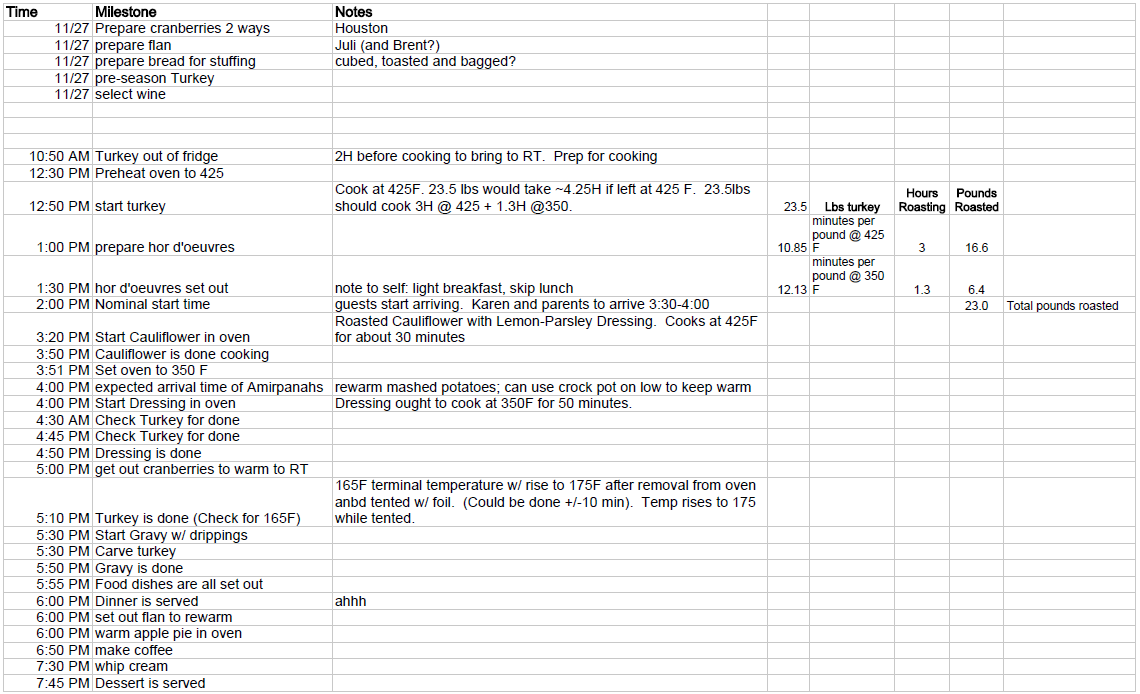
Thanksgiving planning spreadsheet
Does anyone else use a spreadsheet to plan their Thanksgiving meal?
 This level of planning allows me to serve on time +/- 15 minutes.
Monday, August 12, 2013

Saturday, August 10, 2013

Subscribe to:
Comments (Atom)